


Microsoft Partner

Call Now:+44 7460 073 228

Business Central RFID for retail

Put RFID to work at the till and in the stockroom: faster checkout, quicker counts and stock records you can trust, all connected to Business Central.

One tag at the till and in the stockroom

BC4 is a UK Microsoft Dynamics 365 Business Central partner. We use RFID across the complete retail solution we deliver on Business Central, at the point of sale and in the stockroom.

An RFID tag lets a reader identify many items at once, without lining up a barcode. In a store that matters in two places: checkout, and knowing what stock you really have.

At the till, items go into an RFID bin and the point of sale picks up every tag in it automatically, so nothing is scanned one item at a time. Around the store and in the stockroom, handheld and fixed readers count tagged stock in bulk, so replenishment, online availability and finance all work from the same numbers.

Business Central does not read tags by itself, so the reads reach your point of sale and your stock records through an integration that we set up and support. RFID is not right for every product, and we will say so. Barcodes still win in some places, so we look at where tags pay off before recommending anything.

What changes with item-level visibility

At the till

Checkout without scanning item by item

With an RFID checkout bin, items are dropped in and the point of sale picks up every tag at once and builds the sale automatically. It suits clothing and other tagged goods that would otherwise be scanned one by one.

  • No lining up barcodes, so queues move faster
  • Works for staffed and self-service checkout
  • Sales post to stock in Business Central as they happen
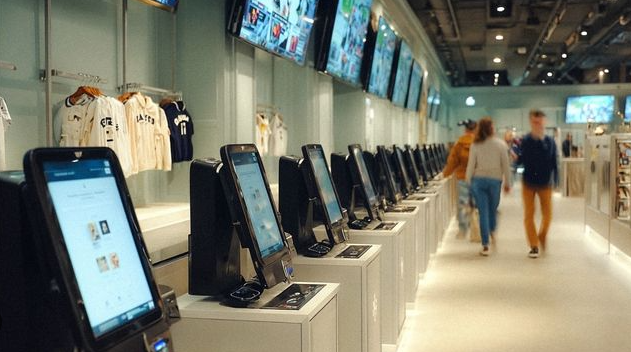
A row of self-service tills in a store
Stock accuracy

Counts you can trust

Handheld and fixed readers read tagged items in bulk, so a stock take that took hours can be done far quicker, and the numbers hold up.

Those reads feed your stock records in Business Central, so what you see on screen matches the shop floor and the stockroom.

A member of staff scanning stock with a handheld reader
Where it fits

RFID and barcodes together

RFID suits bulk reads of tagged goods in open space. Barcodes are often better where someone needs to confirm the exact item, or where products are metal, liquid or tightly packed.

  • Checkout bins and bulk counts for tagged stock
  • Barcode scanning where exact confirmation matters
  • A mix planned around your products, not a single rule
  • A pilot in one store before a wider rollout

RFID features built around your stores

RFID works best when it is planned around your products and your processes. These are the areas we cover with you.

RFID checkout

Drop items into a checkout bin and the point of sale reads every tag at once, then builds the sale for the customer or the assistant.

Faster stock takes

Read tagged items in bulk instead of scanning one at a time, so stock takes finish sooner.

Right stock, right place

Knowing what is on the shelf and in the stockroom means fewer stock-outs and less time hunting for items.

Connected to Business Central

Sales and counts from RFID update your Business Central stock records, so finance, buying and the shop floor work from the same inventory figures.

RFID partners Frequentiel RFID and Unitech

Frequentiel RFID

RFID technology that gives retailers item-level visibility of stock, helping stores and distribution centres keep inventory records accurate.

About Frequentiel RFID and BC4

Unitech

Rugged mobile computers, barcode scanners and RFID readers built for in-store mobility, stock counts and scanning.

About Unitech and BC4

Tags have a cost per item, and some suppliers do not tag goods at source. We cover both before you commit.

Is it time to look at RFID?

It is usually the right time when

  • Checkout queues build up because items are scanned one by one
  • Stock accuracy is a recurring problem across stores
  • You hold high volumes of small, similar items such as clothing
  • Goods can be tagged at source or at goods in
  • You run several stores or distribution centres

It may be too early if

  • Most of your stock is metal or liquid, which tags handle poorly
  • Barcode scanning is already quick and accurate
  • You hold few items at a single site
  • Tagging in house would cost more than it saves

If that sounds like you, barcode scanning and good counting routines may be the better answer. We can help with either.

Frequently asked questions

What is RFID in retail?

RFID uses a small tag on each item that a reader can identify from a distance, many at a time, without lining up a barcode. In retail it is used in two main places: at the point of sale, where a reader picks up every tagged item in a checkout bin, and in the store and stockroom, where readers count stock in bulk.

How does RFID checkout work?

Items are placed in an RFID checkout bin, and the reader picks up every tag in it at once. The point of sale then builds the sale automatically, so nothing is scanned one item at a time. It can be used with staff at the till or as part of a self-service set-up.

Does Business Central support RFID?

Business Central does not read RFID tags on its own. Tag reads are brought into your point of sale and stock records through an integration. BC4 works with Frequentiel RFID to feed item-level data into Business Central and LS Central, and with Unitech for readers.

Is RFID better than barcodes?

Neither is better everywhere. RFID is good for reading many tagged items quickly, such as a basket of clothing or a rail in a stockroom. Barcodes are often better when someone must confirm one exact item, or for metal and liquid products. Many retailers use both.

What does RFID cost?

The main costs are the tags, the readers, any checkout hardware and the integration. Tag costs depend on the volume and who applies them. We look at your products and processes first, so you can see whether tags would pay for themselves before you commit.

Can RFID work in a small number of stores?

Yes. The approach works from a single site to a whole estate. A pilot in one store or stockroom is often a sensible way to prove the benefit before rolling out further.

How accurate will our stock records be?

Accuracy depends on how well items are tagged and how counts are done. RFID gives item-level visibility, but we do not promise a fixed accuracy figure. We agree how success will be measured with you before starting.

What devices do we need?

Counting needs RFID readers, which can be handheld or built into mobile computers, and checkout needs a reader built into a bin or counter. Unitech supplies rugged mobile computers, barcode scanners and RFID readers for retail. We check compatibility with your set-up rather than assuming a device will work.

Talk to us about RFID in your stores

Whether you want to speed up checkout, improve counts in one store or across a whole estate, we can help you work out whether RFID is the right step.