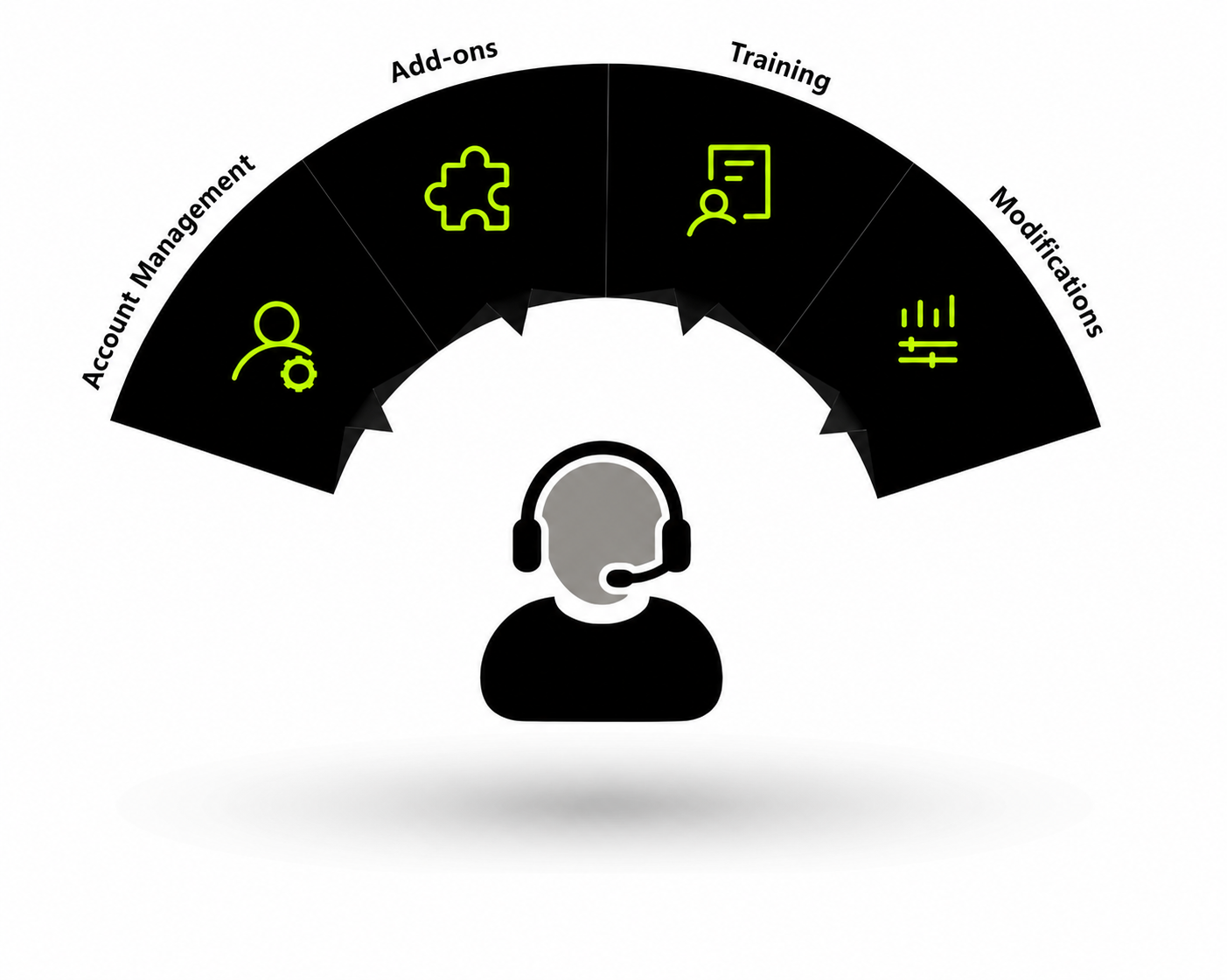

We specialise in moving complex businesses from Dynamics NAV to Microsoft Business Central. Here is how we do it:
Microsoft ends extended support for Dynamics NAV on 11 January 2028. For businesses running complex retail, multi-site or omnichannel operations, waiting until the deadline is not a plan, it is a risk.
2028, Microsoft's final extended support date for Dynamics NAV 2018
months, typical migration timeline for complex, multi-entity businesses
NAV, is already fully out of support along with 2016, 2015 and 2013
Microsoft will no longer issue patches for new vulnerabilities. Any gaps discovered after January 2028 will remain open forever, leaving your systems and data exposed.
Tax rule changes, VAT updates and compliance requirements will not be reflected in NAV. Running an unsupported system creates an increasing burden for your finance team.

Microsoft engineers will no longer assist with NAV issues. Third-party support is available, but it becomes harder to find and more expensive as the talent pool shrinks.

Continuing to run NAV beyond January 2028 is technically possible. But the risks are real, measurable, and they grow every month you delay.

Yes, but only for NAV 2018, and only until 11 January 2028.
Microsoft still provides security patches and critical fixes for NAV 2018 under its extended support programme. However, no new features, no regulatory updates and no non-security bug fixes are included. If you are running NAV 2017, 2016, 2015 or 2013, your system is already fully unsupported today.
What this means for your risk:
The closer you get to January 2028, the less time you have to plan, migrate and test without pressure. A business that starts now has options. A business that waits until late 2027 is forced into a rushed programme, with fewer available partners, higher costs and greater risk of disruption.

We specialise in moving complex businesses from Dynamics NAV to Microsoft Business Central. Here is how we do it:
We map your current process to Business Central and design your future-state configuration, including any vertical extensions.
We structure the right licensing model for your business and give you a clear cost picture before the projects start.
We extract, cleanse and restructure your NAV data to the Business Central model, including transactions, stock and customer records.
We build and configure Business Central to your requirements including POS integrations, third-party connections and custom extensions.
Your team tests the system against real business scenarios before go-live, giving you confidence before you switch over.
We migrate your live data and reconcile it against source records to confirm accuracy across finance, stock and operations.
We train your teams, manage the cutover and stay close through the first ninety days to ensure a smooth transition.
The deadline is January 2028. So why start now? Because ERP migrations are not like flipping a switch, and the later you leave it, the harder it gets.
The closer you get to January 2028, the more congested the market becomes. Experienced implementation partners are already seeing strong demand for 2026 and 2027 start dates. If you are planning a migration, the right time to scope it is now.
BC4 is a Microsoft Dynamics partner and LS Retail partner working with retail, sports and hospitality operators across the UK and Europe. Browse client outcomes on our case studies page.
The closer we get to January 2028, the less room there is to plan on your terms. Speak to a BC4 specialist today to scope your migration, understand your timeline and get a clear view of cost and risk.
Trusted by:
.png?width=132&height=76&name=image%20(2).png)
Extended support for the final release, NAV 2018, ends on 11 January 2028. All earlier versions are already out of support.
Only NAV 2018 still receives extended support, which provides security updates. Mainstream support, covering new features and non-security bug fixes, has ended for every version of NAV.
No. The software will continue to run. It just will not receive Microsoft security patches, which leaves it increasingly exposed and harder to keep compliant.
Yes. We regularly upgrade clients from older NAV releases directly to Business Central, without needing intermediate version upgrades.
Business Central is the cloud-first evolution of NAV. Same product family, same underlying logic, with a modern interface, Power Platform integration, AI-assisted reporting and ongoing updates.