
How to Run Retail Point of Sale Platforms Offline and Sync Sales Later
AI is everywhere in retail right now, but most of the conversation is still too vague. Retail leaders are hearing about copilots, assistants, automation, and agents, often without a clear picture of what any of it means in practice.
That is where the idea of agentic AI becomes useful. Agentic systems do not just generate content or answer prompts. They can take context, reason across tasks, and help move work forward in a structured way.
For retailers already running or reviewing Microsoft Dynamics 365 Business Central, that opens up a more practical question: where can AI agents create real operational value inside an ERP-led retail environment?
What Do We Mean by Agentic AI?
In simple terms, an agentic AI system is one that can work toward an outcome, not just produce a one-off answer. That might include gathering the right context, identifying missing information, suggesting next actions, and in some cases triggering approved workflows or updates.
Used properly, this makes AI much more relevant to retail operations. Retail teams are not short of data. They are short of time, clarity, and operational capacity. Agentic systems can help reduce friction across the decisions and workflows that sit between insight and action.
Why This Matters in Retail
Retail businesses run on connected operational decisions. Stock, pricing, purchasing, fulfilment, store execution, finance, promotions, and reporting all affect one another. The problem is not simply that there is too much work. The problem is that too much of it is fragmented.
That is why agentic AI matters. In the right environment, it can help retailers:
-
surface the next best action from live operational data
-
flag exceptions before they become bigger problems
-
assist teams with repetitive process steps
-
reduce lag between reporting and action
-
support better coordination across retail, warehouse, finance and customer operations
The point is not to replace people. It is to reduce operational drag and make the organisation easier to run.
How Agentic AI Fits with Microsoft Business Central
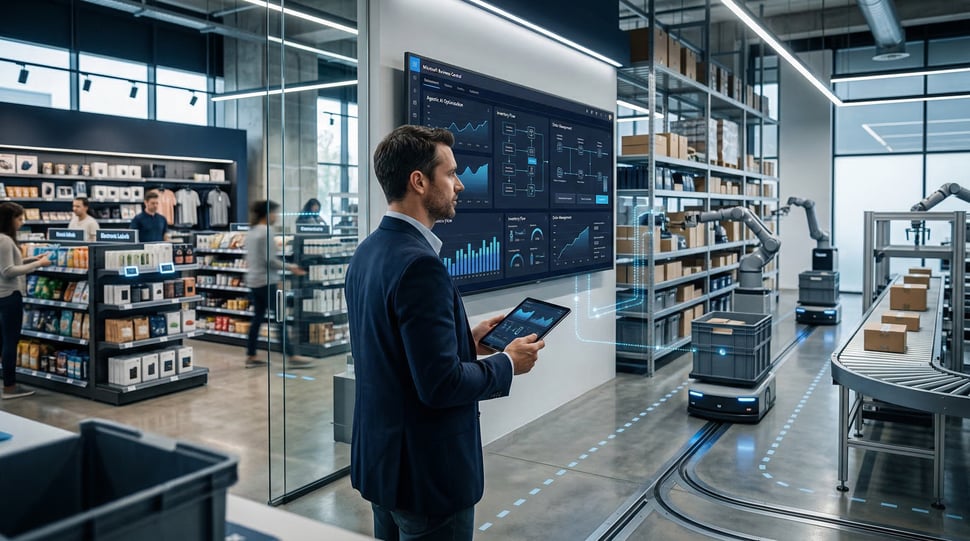
Microsoft Dynamics 365 Business Central already provides the core commercial and operational backbone for many retailers. It holds the data and processes that matter: purchasing, inventory, financials, workflows, approvals, item management, and reporting.
That makes it a strong foundation for agentic AI. If the ERP is already the source of operational truth, AI agents can be used around it in ways that are practical rather than gimmicky.
Examples include:
-
Inventory and stock monitoring agents that identify unusual movement, low-stock risk, replenishment gaps, or mismatches between expected and actual behaviour
-
Purchasing support agents that highlight exceptions, missing approvals, or supplier-related issues before they slow down operations
-
Service and operations agents that summarise issues, surface trends, and help teams coordinate faster across multiple systems
-
Sales and account agents that use CRM and ERP context together to prepare account summaries, next-step plans, and follow-up actions
-
Reporting and insight agents that turn operational data into commentary, escalation prompts, or action-oriented summaries
This only works properly if the underlying operating model is sound. AI cannot rescue poor process design or weak system architecture. But where Business Central is part of a connected retail estate, agentic AI can make that model more responsive and more scalable.
Where Retailers Should Start
The mistake many businesses make is trying to begin with the most ambitious AI use case. In reality, the best place to start is with repeatable operational friction.
That usually means looking at areas like:
-
stock exceptions
-
approval bottlenecks
-
manual reporting effort
-
reactive service or support workflows
-
slow coordination between systems or teams
These are the situations where an agentic layer can create immediate value: not by replacing the ERP, but by helping people act on the ERP more effectively.
This is also why agentic AI should be seen as part of a broader connected retail architecture. If the business is already struggling with fragmented systems and weak data ownership, AI will simply expose those problems faster.
What Good Looks Like
A strong agentic AI model in retail is not flashy. It is useful.
It helps teams:
-
make faster operational decisions
-
reduce time spent chasing data across systems
-
spot issues earlier
-
maintain tighter control over inventory, purchasing and fulfilment
-
connect reporting to action in a more disciplined way
For retailers using Microsoft Business Central, the opportunity is not just automation. It is creating a more intelligent operating layer around the ERP backbone.
How BC4 Approaches Agentic AI
BC4 sees agentic AI as part of the next phase of connected retail operations. The real opportunity is not generic AI tooling. It is designing useful, controlled, commercially relevant agents around the systems that already run the business.
That means understanding the retail operating model first, then identifying where AI can improve control, visibility, speed and execution. In environments built around Microsoft Dynamics 365 Business Central, that can be especially powerful because the ERP already provides the core process and data structure needed to make agents useful.
It also connects naturally to the broader themes we already see in modern retail transformation: better decisions from better operational data, stronger connected operations, and a more scalable model for retail growth.
FAQ
What is agentic AI in retail?
Agentic AI refers to AI systems that do more than answer questions. They can work toward outcomes by using context, surfacing next actions, identifying issues, and supporting operational workflows.
Can agentic AI work with Microsoft Business Central?
Yes. Business Central can provide the operational and data backbone that makes agentic AI useful, particularly across inventory, purchasing, reporting, service, and retail operations.
Does this replace ERP users or teams?
No. The goal is not to replace people. The goal is to reduce operational friction, improve decision-making, and help teams work more effectively using the systems already in place.
Where should retailers start?
Start with repeatable operational friction such as stock exceptions, approval delays, reactive reporting, or support workflow bottlenecks. These are usually the clearest early opportunities.
Conclusion
Agentic AI will matter in retail where it helps the business operate better, not where it simply adds more noise to the technology stack.
For retailers using Microsoft Dynamics 365 Business Central, the real opportunity is to build an intelligent operational layer around the ERP backbone: one that improves visibility, speeds up action, and helps teams manage complexity more effectively.
Speak to BC4 if you want to explore where agentic AI could create practical value across your retail and ERP landscape.